How Much Exercise Does a English Bulldog Need? Plus Brain Games
General training information. Every dog is an individual; for health or behavior concerns, see your veterinarian.
If you are wondering how much exercise an English Bulldog needs, the short answer is: less than you might think, and gentler than most breeds. The longer answer covers heat, pacing, and what to do with the rest of the day so your dog does not get bored.
This guide gives you a step-by-step plan for English Bulldog exercise and English Bulldog mental stimulation. It leans on published breed sources, and it tells you where to ask your veterinarian instead of guessing.
The Quick Answer
PetMD describes the Bulldog as a breed that needs gentle exercise only. It recommends short, leashed walks in a cool environment, and nothing strenuous. Orvis says a 20-minute walk is usually enough for an adult.
The Westminster Kennel Club rates the breed's energy level at 3 out of 5. That is middle of the road. Your dog likes to move and play, but does not need a marathon.
Note that the American Kennel Club and Westminster simply call the breed the Bulldog. People often say English Bulldog, and this article uses that name too.
Why This Breed Needs a Different Plan
PetMD lists breathing problems, skin fold infections, hip dysplasia, entropion and obesity among the common health issues in Bulldogs. It also points to heat intolerance, because the breed has a short, flat face.
That list explains the exercise advice. Too much effort, or effort in warm weather, can be hard on a dog that already works to breathe. Too little movement, combined with food, can add weight, and extra weight makes every other problem harder.
So the goal is steady, easy movement, plus plenty of brain work that does not strain the body. Individual dogs vary, and your veterinarian is the right person to set limits for yours.
Materials You Will Need
- A flat collar or a well-fitted harness. Your vet can advise which suits your dog's breathing. Do not use prong, choke or shock collars.
- A standard leash, not a retractable one, so you can keep the pace slow and steady.
- Fresh water, and a way to carry it on walks.
- Small, soft treats. PetMD advises limiting treats during training to avoid weight gain, so count them as part of the daily food.
- A puzzle feeder, snuffle mat or lick mat.
- A few old towels, cardboard boxes or paper bags for homemade games.
- A cool, shaded or indoor space for play.
- A simple notebook or phone note to track walks, treats and weight.
Step-by-Step: Building a Safe Exercise Routine
Step 1: Get a veterinary check first
Before you start any routine, ask your veterinarian about your dog's breathing, joints and weight. Ask what walk length is safe right now, and what signs mean it is time to stop.
The Bulldog Club of America lists cardiac, patella and trachea screens as required for the CHIC program. Ask your breeder or vet what testing your dog's family has had, and what it means for activity.
Step 2: Pick the right time and temperature
PetMD stresses a cool environment. Plan walks for early morning or late evening, and skip them on hot or humid days. Check the pavement with the back of your hand. If it feels too warm for you, it is too warm for your dog.
No source in our research gives a specific safe temperature number. Ask your veterinarian what cutoff makes sense where you live.
Step 3: Start with short, slow walks
Aim toward the 20-minute walk Orvis describes as usually enough, but build up to it. A new dog, an out-of-shape dog or a heavier dog may do better with several shorter outings. Two or three short strolls can work better than one long one.
Keep the pace easy. Let your dog stop, sniff and look around. This is a stroll, not a workout.
Step 4: Watch your dog, not the clock
Stop and rest in the shade if your dog slows down, lags behind, pants hard or seems unwilling to continue. Do not drag or coax a tired dog along to hit a time target.
If you see noisy or labored breathing, collapse, or heavy panting that does not ease with rest, contact a veterinarian right away. Do not try to diagnose it at home.
Step 5: Add easy indoor play
On days that are too hot or wet, swap the walk for gentle indoor games. Try a slow game of tug with a soft toy, or toss a treat a short distance down the hallway. Keep sessions brief, and end them while your dog is still interested.
Step 6: Keep a simple log
Write down walk times, treats and any odd breathing or limping. A log helps your vet spot patterns. It also helps you notice slow weight gain before it becomes a problem.
Exercise by Life Stage
Puppies
PetMD notes that Bulldog puppies need to eat more often, three or four times daily. The sources we reviewed do not give breed-specific limits for puppy walks or play. They also do not give a growth-plate or joint rule of thumb.
Because of that, ask your veterinarian how much activity is right for your puppy's age. Until then, keep play short, on soft ground, and in cool conditions. Skip stairs, jumping and long walks. Puppies also tire quickly, so let them nap whenever they want.
Puppyhood is a good time for mental work. Short games and early training build good habits without wearing out young joints. For the full foundation, see our complete English Bulldog training guide.
Adults
For a healthy adult, plan on gentle daily movement. A 20-minute leashed walk, per Orvis, is a reasonable target, and PetMD says to keep it cool and not strenuous. Split it into two shorter walks if that suits your dog better.
Seniors
PetMD and Orvis both give a life expectancy of 8 to 10 years. The sources do not give a senior exercise schedule. Ask your veterinarian how to adjust walk length as your dog ages, especially if you notice stiffness, slower breathing or less interest in going out.
Step-by-Step: Brain Games for English Bulldog Mental Stimulation
Mental work tires a dog out without stressing the body. That makes it a great fit for a breed that should not run hard. The Westminster Kennel Club rates Bulldog trainability at 4 out of 5 and describes the temperament as fun-loving, affectionate, outgoing, playful and smart.
Orvis, a retailer and a secondary source, calls the breed stubborn and not highly intelligent. Both views can be true of different dogs. Keep games short and rewarding, and let your own dog show you what it enjoys.
A note on history. Westminster says the breed was originally used for bull baiting. That is a cruel practice and not something to copy. The Bulldog Club of America lists modern activities for the breed instead, including obedience, rally, agility, scent work, tracking and field events. The games below borrow gentle versions of those ideas.
Game 1: The sniff walk
- Pick a quiet, cool route and a loose leash.
- Choose a spot with interesting smells, like a grassy edge or a tree base.
- Stop and let your dog sniff for as long as it likes, unless the spot is unsafe.
- Let your dog lead the direction now and then.
Sniffing is easy on the body and keeps the mind busy. It also fits neatly into a short walk.
Game 2: Find the treat (a starter scent game)
Scent work is one of the activities the Bulldog Club of America lists for the breed. You can try a simple home version.
- Ask your dog to wait, or have someone hold the leash.
- Let your dog watch you place a small treat on the floor a few feet away.
- Say a cue word such as "find it" and let your dog go.
- Praise warmly when your dog eats the treat.
- Over several days, hide treats where your dog cannot see them placed, such as behind a chair leg.
Keep the pieces tiny, and subtract them from the day's meals.
Game 3: Puzzle feeders and snuffle mats
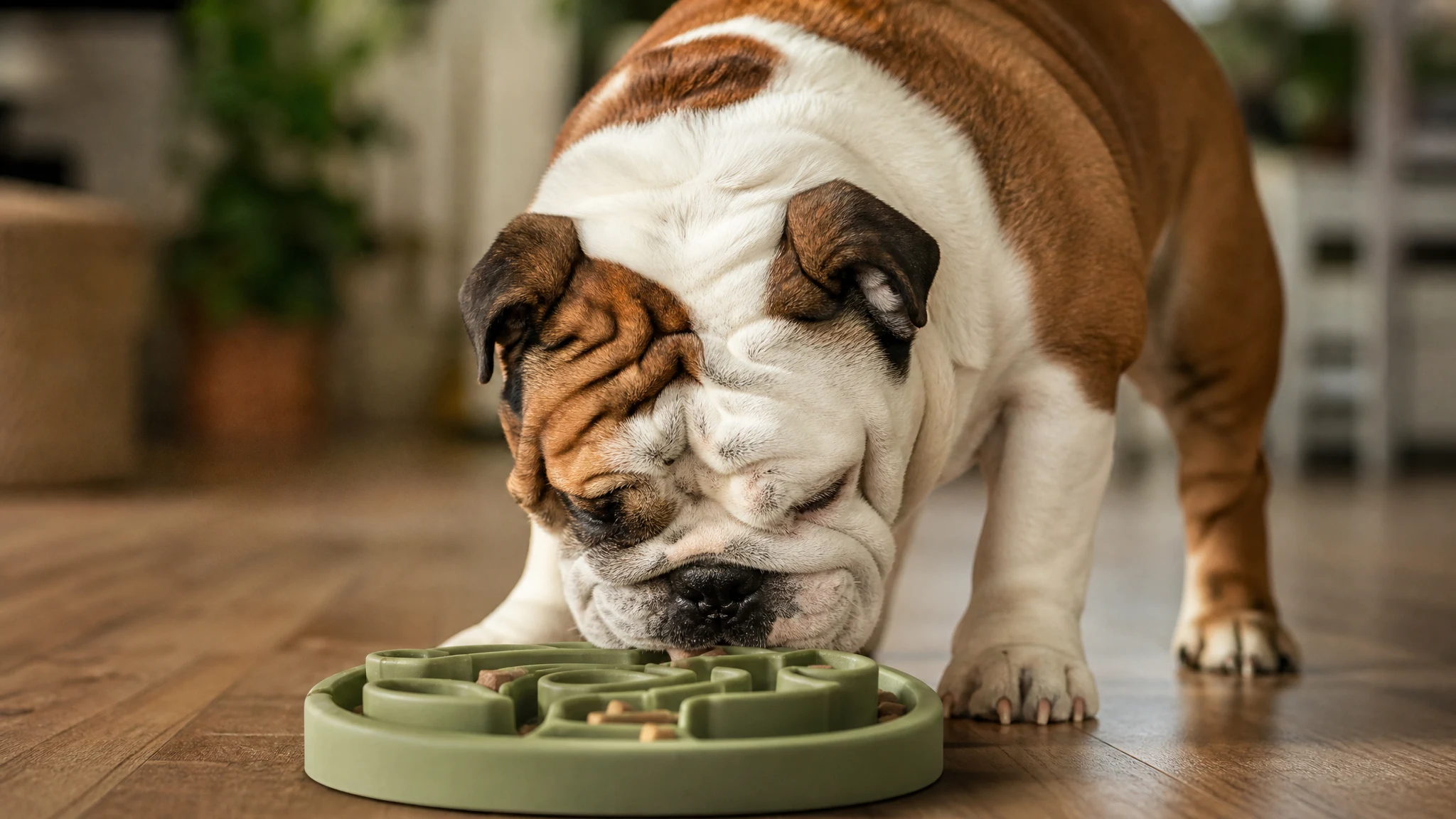
Feed part of a meal from a puzzle feeder, snuffle mat or lick mat. This turns a two-minute meal into a short problem-solving session. Start with the easiest setting so your dog wins early and stays motivated.
Watch the first few tries. Some dogs gulp food or get frustrated. If yours does, make the puzzle simpler.
Game 4: Short training sessions
PetMD says positive reinforcement works best for Bulldogs, and Orvis advises short sessions with praise and rewards. That matches the humane, reward-based approach recommended by the American Veterinary Society of Animal Behavior.
- Pick one skill, such as sit, down, touch or come.
- Work for three to five minutes.
- Mark the right move with a happy word and give a small reward.
- End on a success, even if it is an easy one.
- Repeat once or twice a day.
Obedience and rally are both on the Bulldog Club of America's list of breed activities, so these basic skills can grow into a hobby if you and your dog enjoy it.
Game 5: The towel roll and the box dig
Roll a few treats up in a towel and let your dog unroll it with its nose and paws. Or scatter treats inside a low cardboard box with some crumpled paper. Both are quiet, low-impact and cheap. Supervise, and take away any paper or cardboard your dog starts to swallow.
A Sample Day
| Time | Activity |
|---|---|
| Early morning | Short, cool leashed walk with sniff breaks |
| Breakfast | Meal from a puzzle feeder or snuffle mat |
| Midday | Rest indoors, out of the heat |
| Afternoon | One short training session or a find-it game |
| Evening | Second short walk once it has cooled off |
Adjust this to your dog and your vet's advice. Some days a rest day with only brain games is the right call.
Tips for Success
- Keep sessions short and end on a high note.
- Count every treat toward daily food. PetMD lists obesity as a common Bulldog health issue.
- Carry water and plan shade stops.
- Rotate games so they stay fresh.
- Use praise, toys and affection as rewards too, not only food.
- Stay patient. Orvis notes the breed can be stubborn, so expect some pauses and sit-downs.
Common Mistakes to Avoid
- Walking in the heat. PetMD flags heat intolerance. Choose cool hours.
- Pushing past tiredness. A slow, stopping dog is telling you something.
- Treating exercise as the only outlet. A bored dog may chew or pester. Add mental games.
- Overfeeding treats. Small rewards add up quickly.
- Using force. Never use shock, prong or choke collars, alpha rolls, scruffing or dominance methods. They are not recommended by the American Veterinary Society of Animal Behavior and can damage trust.
- Guessing about health. Noisy breathing, limping or skin problems belong with a veterinarian.
What Results to Expect
With a steady routine, many owners find their dog is calmer at home and easier to manage on walks. Short training sessions may help your dog learn basic cues over a few weeks. Puzzle games may help slow down fast eaters and keep your dog busy at times when you cannot play.
Gentle exercise and careful treat counting may also help you keep your dog at a healthy weight, which your vet can confirm. Every dog is different, and no routine can promise a particular outcome. If something does not seem right, check in with your veterinarian.
Wrapping Up
So, how much exercise does an English Bulldog need? Plan on gentle, cool, leashed movement, roughly in the range of a 20-minute walk for an adult, plus short brain games that do not tax the body. For puppies and seniors, ask your vet for limits, because the sources we reviewed do not give them.
Ready to build the skills behind these games? Start with the complete guide to training an English Bulldog.